At the end of Part I of this look at "non-chess" factors in improving your chess results, I promised that we'd talk about "the psychology of openings, optimism and opening optimism, amongst others," in Part II. This is known in the business as a "tease," hoping to keep the reader on tenterhooks until the next part--the equivalent of the pretty girl, tied up and laying across the railroad tracks in an old Western movie serial.
I doubt that anyone who read the first part has been experiencing that degree of anticipation, but I was very pleased to see that the Portuguese blog Ala de Rei linked to it here--I hope the translation program didn't mangle my thank-you comment too much...anyway, enough preliminary blather, forward to
The psychology of openings, optimism and opening optimism...
Again, these posts aren't going to be about the merits of specific openings, study methods or tactical training as such, but about other factors; attitude, viewpoint, goals and knowing why as well as how.
Openings and optimism
Some weeks back I wrote a series of posts about openings that started some good discussions, including the one in the comments here; one of my main points was that it was a mistake to try to win games in the opening, though of course it's enjoyable if we do get an overwhelming position after very few moves. But it's bad success psychology to hope or expect our opponents to fall into our opening traps or collapse as soon as we make a few aggressive thrusts with the kingside pawns. When and if they don't, it's all too easy to become discouraged and either blunder or try to force the position further with unsound sacrifices. This happens to everyone at times, at least everyone who is not a Master, and it probably happened to all of them once or twice on their way up the ladder. The only good way to approach the opening in my opinion is to mentally prepare for the opponent to play good moves; then if he does so you're not disappointed, and if he does not you are happy to take advantage of his mistakes. Being optimistic before the game means being optimistic that you are going to play good moves, not that he will play bad ones.
In fact, you might feel delight if he plays very well, thus providing you with an opportunity to show your best chess and perhaps play the "game of your life." That's the sort of optimism I believe can really prepare you for the opening, and for the rest of the game as well.
The World in Black and White
I recently ordered Jonathan Rowson's book Chess for Zebras, but it hasn't arrived yet and so I write this without the benefit of having fully read his ideas on playing White and Black (though there's a nice excerpt here). At any rate, in relation to "opening optimism" I recall that early in my chess career, when I was learning a lot and going up the ratings ladder fairly rapidly, I compiled some numbers and found that out of my first 50 or so tournament games I had won slightly more games as Black than as White! Admittedly, this sample wasn't the millions of games that show that in practice White has approximately a 56-44 percent advantage; it was just a sample of my games on the road from a 1200 to a 1400 rating. But looking into things, I realized that as White I was playing 1. e4 and pressing for attack (my "birthright" as White) and as Black I was more flexible and patient, "letting the game come to me" as the saying goes. I soon switched to 1. d4 and became more comfortable with the White pieces but the lesson has stayed with me.
Another thing I've noted with great interest is that in the "Best Games" books of great players like Alekhine and Nunn (two I can think of without actually having the books in front of me) there are a lot more games with Our Hero playing White than with Black, though of course these players won many a game with the Black pieces in their long careers. True, this type of book usually only presents wins by the author, but I think you'll find if you look through a larger sample that most of the "Best Games" books are at well above the 56 percent level (say about 10 wins for White to every 8 for Black) that we know are the actual results of millions of games in the databases. What to make of this?
My theory is simply that when the Grandmasters go through their careers looking for "best" games that will entertain readers (and presumably boost sales) they understand that "attacking" games are mainly what the buyer wants to see (though some exciting attacks resolve into a winning endgame). And the type of game where the author pulls off a beautiful attack is more likely to be with White, as a lot of Black wins at the Master level are longer, tougher fights.
What has all this to do with practical chess psychology? I think a lot of players that these articles are aimed at (say 1200-2000) are a little less confident, a little more uncertain, with Black. Not everybody, mind you, but a good many of us. And I think that in order to be a stronger player you need to embrace the Black pieces--you're going to have them half the time, after all. You need to feel that it's at least as much fun to play Black and that the odds of the opponent making a mistake and giving you an opportunity are just as great when he's White.
That's opening optimism, too.
Perhaps this doesn't completely apply in the to the guys playing in Mexico City for the World Championship, but we can all cross that bridge when we come to it.
(Next time in Part III we'll try to figure out why sometimes it's so much easier to see the right move when you're spectating, rather than playing).
Friday, September 21, 2007


Friday, September 14, 2007
Ernie Hong-Pearson 09.13.07 1-0
After a couple of agonizing weeks without a tournament game (Alaska vacation, last night of family members in town), I finally got back in action against Reno CC Secretary and Expert-rated Ernie Hong (2002).
On move 8, instead of playing the safe c6 and settling in for a tough struggle I play the cute (but actually ugly) Qf5 after a 13-minute think, believing I'm going to shatter his kingside. He can't play 9. g4 because he will end up two pawns down, when I win back the knight...wrong! He thinks for 24 minutes and finds the simple 11. Nd4, which I should have seen if I was really doing my job. After this I'm just trying everything I can to muddy the waters--at one point I even have 5 pawns for two minor pieces! Unfortunately, none of them have any threat going, and after another blunder in 22. ... Nd4 it's really all over, though a queen running through a minefield would have lost quickly, anyway.
To sum up, he shows Expert skillz, and I get a lesson on what I need to do to play better. All in all, it was pretty fun and beneficial for a loss!
Also, the yearly Reno CC organizational meeting was held before the game and I was reelected Sergeant-at-Arms. They gave me a halberd to start cutting up kibbitzers and loud postmortem participants. Seriously, after you game is over, whisper your analysis, dude, or I'm going to lop a couple of fingers with this thing!

[Event "Reno CC Sept. Swiss"]
[Site "Reno, NV"]
[Date "2007.09.13"]
[Time "000"]
[Round "2"]
[White "Hong, Ernie"]
[Black "Pearson, Robert"]
[TimeControl "30/90 G/60"]
[Result "1-0"]
1. e4 d5 2. exd5 Nf6 3. Nf3 Qxd5 4. Nc3 Qa5 5. Bc4 Bg4 6. h3 Bh5 7. d3 e6 8. Bd2 Qf5 9. g4 Nxg4 10. hxg4 Bxg4 11. Nd4 Qe5+ 12. Nde2 Nc6 13. Bf4 Bxe2 14. Nxe2 Qxb2 15. Rb1 Bb4+ 16. c3 Bxc3+ 17. Kf1 Qa3 18. Rb3 Qxa2 19. Nxc3 Qa5 20. Nb5 e5 21. Bd2 Qb6 22. Be3 Nd4 23. Nxd4 Qf6 24. Nb5 0-0 25. Nxc7 Rac8 26. Nd5 Qd6 27. Rxb7 Rfe8 28. Qh5 1-0
On move 8, instead of playing the safe c6 and settling in for a tough struggle I play the cute (but actually ugly) Qf5 after a 13-minute think, believing I'm going to shatter his kingside. He can't play 9. g4 because he will end up two pawns down, when I win back the knight...wrong! He thinks for 24 minutes and finds the simple 11. Nd4, which I should have seen if I was really doing my job. After this I'm just trying everything I can to muddy the waters--at one point I even have 5 pawns for two minor pieces! Unfortunately, none of them have any threat going, and after another blunder in 22. ... Nd4 it's really all over, though a queen running through a minefield would have lost quickly, anyway.
To sum up, he shows Expert skillz, and I get a lesson on what I need to do to play better. All in all, it was pretty fun and beneficial for a loss!
Also, the yearly Reno CC organizational meeting was held before the game and I was reelected Sergeant-at-Arms. They gave me a halberd to start cutting up kibbitzers and loud postmortem participants. Seriously, after you game is over, whisper your analysis, dude, or I'm going to lop a couple of fingers with this thing!

[Event "Reno CC Sept. Swiss"]
[Site "Reno, NV"]
[Date "2007.09.13"]
[Time "000"]
[Round "2"]
[White "Hong, Ernie"]
[Black "Pearson, Robert"]
[TimeControl "30/90 G/60"]
[Result "1-0"]
1. e4 d5 2. exd5 Nf6 3. Nf3 Qxd5 4. Nc3 Qa5 5. Bc4 Bg4 6. h3 Bh5 7. d3 e6 8. Bd2 Qf5 9. g4 Nxg4 10. hxg4 Bxg4 11. Nd4 Qe5+ 12. Nde2 Nc6 13. Bf4 Bxe2 14. Nxe2 Qxb2 15. Rb1 Bb4+ 16. c3 Bxc3+ 17. Kf1 Qa3 18. Rb3 Qxa2 19. Nxc3 Qa5 20. Nb5 e5 21. Bd2 Qb6 22. Be3 Nd4 23. Nxd4 Qf6 24. Nb5 0-0 25. Nxc7 Rac8 26. Nd5 Qd6 27. Rxb7 Rfe8 28. Qh5 1-0

Around the Chessosphere
Pale Morning Dun gives the best damn analysis of the Mexico World Championship tournament:
The nerd-in- training at the end is how I feel about Boris' chances. He's gonna get treated like a little boy at a simul, left dancing with himself and sucking on a bottle of pepsi.
World Championship Prediction : Cinqo.
Oh yeah, there's much more where that came from...
It's official--BlueEyedRook is full of absolute crap. Kudos to him for his fan-atical support of his USCL team, however.
Chessloser--back in black and working at a kitchen gadget store...perfect.
XY has moved from Caught in the Fire to Mythology. Don't know if it will always be about chess, but it will always be interesting.
Blunderprone's rather bogus adventures trying to play in the N.E. Open give us some insight on the challenges of balancing family life and chess. Also, car trouble.
Finally, Rocky Rook has a beautiful post about giving back, and thinking about someone else in the context of chess. Very inspiring and refreshing.
Oh there's a lot more I'd like to highlight, but must run. More soon.
The nerd-in- training at the end is how I feel about Boris' chances. He's gonna get treated like a little boy at a simul, left dancing with himself and sucking on a bottle of pepsi.
World Championship Prediction : Cinqo.
Oh yeah, there's much more where that came from...
It's official--BlueEyedRook is full of absolute crap. Kudos to him for his fan-atical support of his USCL team, however.
Chessloser--back in black and working at a kitchen gadget store...perfect.
XY has moved from Caught in the Fire to Mythology. Don't know if it will always be about chess, but it will always be interesting.
Blunderprone's rather bogus adventures trying to play in the N.E. Open give us some insight on the challenges of balancing family life and chess. Also, car trouble.
Finally, Rocky Rook has a beautiful post about giving back, and thinking about someone else in the context of chess. Very inspiring and refreshing.
Oh there's a lot more I'd like to highlight, but must run. More soon.
Tuesday, September 11, 2007
"Practical" Chess Psychology (Part I)
I'm not a psychologist, psychiatrist, "success coach," guru or shaman, but I'd be willing to play any of these on TV for $100,000 per week--have your people call my people and discuss.
Despite these lacks, I am a reasonably successful professional (that is, I work for The Government in an Undisclosed Location and am entrusted with important Confidential Information that I'd like to share with you, but then I'd have to kill you, &tc.)...
Let's see, what's the point and where the hell was I?
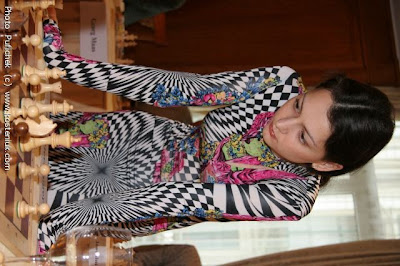
Chess psychology--hot babe GM hypnotizes opponents with FAR-out threads
Oh right, this is supposed to be a chess blog and I really am going to approach the Point, if in a roundabout way. Despite my lack of professional credentials I have indeed read and studied hundreds of books, articles and audio presentations on success psychology, personal improvement, happiness and health, and I think that there are some things I've picked up in these fields that can help us score more points in our games. This isn't about how to study chess, what to study, or actual chess moves as such. It's about attitude, viewpoint, goals and knowing why as well as how.
score more points in our games...
This is the first major break point, right here--before we get too far into this we need to define why we're playing a chess game, what type of game (tournament, internet, blitz, casual) we're talking about, and identify our desired result in the larger picture of our chess career, and life. This post and the Parts that might follow will focus on "serious" chess, that is rated over-the-board and internet games with longer time controls (29 minutes per side and longer). Blitz and casual chess have their own special considerations, and I might take them up sometime later.
You may be saying right now, "Well, my desired result is simply to win this game, the next game, in sum, when I sit down to play chess I want to win every game, though I know that's not really feasible."
In general, this is true, and admirable, but I think a first step forward in the area of chess psychology is to get outside of the moment and take a broader view of chess results. For example, in a few weeks I'm going to be playing in the Western States Open, a big six-round Swiss. I will be one of the lower-rated players in the Class B (1600-1800) section. I would like to score 6/6 and achieve Chess Perfection, realize that 5/6 will almost certainly win first prize and a considerable sum of $$$, and recognize that 3/6 would be a good performance and would advance my USCF rating by a decent interval...so let's say I win my first round against a 1700 player, and after 5 hard hours of play in round 2 I can barely see straight (it will be midnight) and can either take a perpetual check or make an unclear sacrifice of a piece that I am unable to calculate to any conclusion. At this point it will be nice to have thought in advance about what I am playing for, what I feel is an acceptable risk over the board and how it will affect the rest of my tournament. Maybe I don't care about externals, tournament position or ratings--I'm a chess Romantic and I always play to win. Maybe I make a tournament-strategic decision to make a draw, go home and sleep and come back tomorrow at 1.5/2. Defining my goals in advance would make the decision a lot easier.
The Psychology of Ratings
Most of the time, these considerations don't apply and we play to win from move 1--or do we? There is a lot to be considered right here, before the first move is made. I'm going to get to the psychology of openings in the next Part, but another point that has a bearing on the "serious" chess I'm talking about is the comparative ratings of the two players.
All of us, I dare say, love to defeat higher-rated players and don't want to lose to lower-rated players. This is just a fact, and not something to be ashamed of or too concerned about. But it can affect the way we play the game in several ways, most of them not very constructive for maximizing our potential to score more points.
First off, many lower-rated players have a serious inferiority complex when facing much higher-rated opposition. A 1500 often plays a 2000 with the attitude "There's just no way I can beat this guy; he's an Expert, 'a book in the opening, a magician in the middlegame and a machine in the endgame' " (quote from GM Rudolf Spielmann).
Bollocks! The 2000 probably feels the same way when he plays a 2500-rated IM. He's a human and he's going to make mistakes in the course of the game. Don't "believe in" his moves as always good, or you might as well just not play.
In his very interesting book Chess for Tigers Simon Webb advised that when playing a stronger player one should attempt to tactically complicate the position as much as possible, on the theory that there is a greater chance that the stronger opponent will make a losing mistake in such a position, whereas he will generally grind you down if the game is "simple chess" or an ending. While there is some merit to this argument, I think it's easy to take it too far, play some junk "attacking" opening or unsound sacrifice and then end the fight with the thought "well at least I tried to complicate."
My view after many years of tournament experience is somewhat different--regardless of the opponent's rating, play what you believe to be the best move at each turn. This will simplify your life, as you won't need to consider the opponent's rating while trying to calculate and plan. If you love wild attacking chess, play it against both stronger and weaker opposition--you may lose a few points against the lower rated, but you will be true to your chess vision and enjoy the game more than if you are constantly trying to adjust your play based on the other person's rating. Simon Webb was a GM and a very fine writer, but personally I don't try to take rating into account in my choice of moves.
It can be useful to consider ratings in one area, and that is in playing for a draw or for a win, or accepting or rejecting draw offers. Some scenarios:
You're rated 200 points higher than your opponent and you consider the position on the board "very drawish," say rook and three symmetrical pawns each. You both have plenty of clock time. He offers a draw. Accept or play on?
The same situation, only you're 200 points lower?
In a sudden-death time control, you have two minutes, she has 10, but you're up a pawn in an ending that might take 25 moves to win. She offers a draw...
I'm not going to tell you what you should do in these types of situations, I'm just suggesting that you give some thought to your goals in a rated game before the game starts. Based on rating and tournament situation, is a draw okay or not? In the spirit of "scoring more points" I'd say never lose when you could make a draw, whatever the ratings or other considerations. But this is experience talking--I've not always followed this advice in the past. Perhaps you can use my hard-won experience and avoid some painful defeats.
(In Part II we'll talk the psychology of openings, optimism and opening optimism, amongst others).
Despite these lacks, I am a reasonably successful professional (that is, I work for The Government in an Undisclosed Location and am entrusted with important Confidential Information that I'd like to share with you, but then I'd have to kill you, &tc.)...
Let's see, what's the point and where the hell was I?

Chess psychology--hot babe GM hypnotizes opponents with FAR-out threads
Oh right, this is supposed to be a chess blog and I really am going to approach the Point, if in a roundabout way. Despite my lack of professional credentials I have indeed read and studied hundreds of books, articles and audio presentations on success psychology, personal improvement, happiness and health, and I think that there are some things I've picked up in these fields that can help us score more points in our games. This isn't about how to study chess, what to study, or actual chess moves as such. It's about attitude, viewpoint, goals and knowing why as well as how.
score more points in our games...
This is the first major break point, right here--before we get too far into this we need to define why we're playing a chess game, what type of game (tournament, internet, blitz, casual) we're talking about, and identify our desired result in the larger picture of our chess career, and life. This post and the Parts that might follow will focus on "serious" chess, that is rated over-the-board and internet games with longer time controls (29 minutes per side and longer). Blitz and casual chess have their own special considerations, and I might take them up sometime later.
You may be saying right now, "Well, my desired result is simply to win this game, the next game, in sum, when I sit down to play chess I want to win every game, though I know that's not really feasible."
In general, this is true, and admirable, but I think a first step forward in the area of chess psychology is to get outside of the moment and take a broader view of chess results. For example, in a few weeks I'm going to be playing in the Western States Open, a big six-round Swiss. I will be one of the lower-rated players in the Class B (1600-1800) section. I would like to score 6/6 and achieve Chess Perfection, realize that 5/6 will almost certainly win first prize and a considerable sum of $$$, and recognize that 3/6 would be a good performance and would advance my USCF rating by a decent interval...so let's say I win my first round against a 1700 player, and after 5 hard hours of play in round 2 I can barely see straight (it will be midnight) and can either take a perpetual check or make an unclear sacrifice of a piece that I am unable to calculate to any conclusion. At this point it will be nice to have thought in advance about what I am playing for, what I feel is an acceptable risk over the board and how it will affect the rest of my tournament. Maybe I don't care about externals, tournament position or ratings--I'm a chess Romantic and I always play to win. Maybe I make a tournament-strategic decision to make a draw, go home and sleep and come back tomorrow at 1.5/2. Defining my goals in advance would make the decision a lot easier.
The Psychology of Ratings
Most of the time, these considerations don't apply and we play to win from move 1--or do we? There is a lot to be considered right here, before the first move is made. I'm going to get to the psychology of openings in the next Part, but another point that has a bearing on the "serious" chess I'm talking about is the comparative ratings of the two players.
All of us, I dare say, love to defeat higher-rated players and don't want to lose to lower-rated players. This is just a fact, and not something to be ashamed of or too concerned about. But it can affect the way we play the game in several ways, most of them not very constructive for maximizing our potential to score more points.
First off, many lower-rated players have a serious inferiority complex when facing much higher-rated opposition. A 1500 often plays a 2000 with the attitude "There's just no way I can beat this guy; he's an Expert, 'a book in the opening, a magician in the middlegame and a machine in the endgame' " (quote from GM Rudolf Spielmann).
Bollocks! The 2000 probably feels the same way when he plays a 2500-rated IM. He's a human and he's going to make mistakes in the course of the game. Don't "believe in" his moves as always good, or you might as well just not play.
In his very interesting book Chess for Tigers Simon Webb advised that when playing a stronger player one should attempt to tactically complicate the position as much as possible, on the theory that there is a greater chance that the stronger opponent will make a losing mistake in such a position, whereas he will generally grind you down if the game is "simple chess" or an ending. While there is some merit to this argument, I think it's easy to take it too far, play some junk "attacking" opening or unsound sacrifice and then end the fight with the thought "well at least I tried to complicate."
My view after many years of tournament experience is somewhat different--regardless of the opponent's rating, play what you believe to be the best move at each turn. This will simplify your life, as you won't need to consider the opponent's rating while trying to calculate and plan. If you love wild attacking chess, play it against both stronger and weaker opposition--you may lose a few points against the lower rated, but you will be true to your chess vision and enjoy the game more than if you are constantly trying to adjust your play based on the other person's rating. Simon Webb was a GM and a very fine writer, but personally I don't try to take rating into account in my choice of moves.
It can be useful to consider ratings in one area, and that is in playing for a draw or for a win, or accepting or rejecting draw offers. Some scenarios:
You're rated 200 points higher than your opponent and you consider the position on the board "very drawish," say rook and three symmetrical pawns each. You both have plenty of clock time. He offers a draw. Accept or play on?
The same situation, only you're 200 points lower?
In a sudden-death time control, you have two minutes, she has 10, but you're up a pawn in an ending that might take 25 moves to win. She offers a draw...
I'm not going to tell you what you should do in these types of situations, I'm just suggesting that you give some thought to your goals in a rated game before the game starts. Based on rating and tournament situation, is a draw okay or not? In the spirit of "scoring more points" I'd say never lose when you could make a draw, whatever the ratings or other considerations. But this is experience talking--I've not always followed this advice in the past. Perhaps you can use my hard-won experience and avoid some painful defeats.
(In Part II we'll talk the psychology of openings, optimism and opening optimism, amongst others).
Monday, September 03, 2007
The First Blog Carnival is UP
Here we go--and despite the fact that I read a lot of chess blogs I discovered some excellent new sites through this Carnival.
Thanks to Jack Le Moine for putting it together!
Thanks to Jack Le Moine for putting it together!
Subscribe to:
Posts (Atom)